Showing posts with label United States. Show all posts

Thursday, September 29, 2011

The last journey of James K. Polk

Among a lot of other things this blog is about journeys. Usually they involve myself and one of several different co-conspirators but since (a) I have made the trip to our next Governor's grave many, many times and (b) the truly interesting journey this time wasn't made by myself but by the Governor himself. I figured I would spend a little time telling you about his journey and how his earthly remains ended up where they currently rest.

On June 15, 1849, just a short 103 days after leaving the office of President, James K. Polk succumbed to what was likely cholera, breathing his last words to his wife, “I love you, Sarah, for all eternity, I love you."  Over the course of the next several decades the remains of James K Polk would be moved twice and finally end up, along side his wife, at the Tennessee State Capitol.
McKendree Methodist Church, location of James K Polks Funeral
Due to the fear of that a possible cholera epidemic could be caused by his remains, his funeral would take place the day after his death. The funeral service was held at Mckendree Methodist Church, following which James would be interred at the Nashville City Cemetery on June 16, 1849. This cemetery is also the final resting place of Governor William Carroll, who I covered in a previous blog. Many notables of the early history of Nashville are buried in this cemetery so it would stand to reason that James K. Polk would end up here as well. This, however, was never meant to be the final resting place as the intent was to place him here until the monument that was being made in his honor could be completed. The actual location within the graveyard has been lost to time but based on cemetery records it was located on Central Avenue within the grounds of the cemetery.
Central Avenue at the Nashville City Cemetery
He would remain at the City Cemetery until May 22, 1850, when he was exhumed and re-interred in the front yard of his home, Polk Place, which was located in downtown Nashville. At this location the monument, designed by the architect of the Tennessee State Capitol , William Strickland, was placed on his grave.  Sadly, despite his wishes of remaining at this location, and willing his estate to the State of Tennessee to ensure that this would happen, shortly after Sarah's death, he was again moved
Polk Place, circa 1880
On September 19, 1893, the remains of both James and Sarah were removed from their property and placed on the grounds of the Tennessee State Capitol where they remain to this day. Tragically, in 1901, Polk Place would be demolished by the State.
The historic marker at the location where Polk Place once stood
So there you have it, the last journey taken by the12th Governor of Tennessee and the 11th President of the United States, one that took him 44 years, 3 months, 5 days to complete, and that ended at his current and hopefully final resting place.
(see after the Governor bio for bonus pictures)
#12
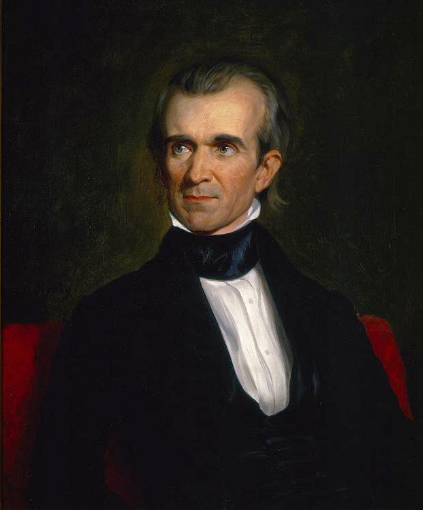
Name: James Knox Polk
Birth: 2 November 1795
Death: 15 June 1849
Age at Death:  53 years, 7 months, 12 days old
Interment: Tennessee State Capitol
Term in Office: October 14, 1839 – October 15, 1841
Pollitical Party: Democrat

James K and Sarah Polk's monument as it looks today
James Knox Polk was born on November 2, 1795 to
Samuel and Jane Polk in Mecklenburg County,
North Carolina. The family would move to the Nashville area when he was still a child. Graduating from the University of North Carolina he would return to Nashville to practice law, apprenticing under Felix Grundy. He would go on to open his own law practice in Columbia, TN, where he would meet and work with another future Governor, Aaron V. Brown. In 1823, his political career began when he won a seat on the Tennessee State Legislature. He would marry his wife, Sarah Childress, the following year on January 1, 1824. The two would never have children, likely the result of a surgery that James had as a child to remove urinary tract stones, leaving him sterile. In 1825, he was elected to the United States Senate, where he would spend the next 14 years. Becoming the Speaker of the House in 1835, he worked tirelessly pushing the agenda of fellow Tennessean, President Andrew Jackson, earning himself the nickname 'Young Hickory'.  At the bequest of Jackson, Polk left congress in 1839 and returned to Tennessee to run for Governor of the State. Defeating Newton Cameron, James would only serve one term and be defeated in the next two Gubernatorial races in 1841 and 1843 by James C. Jones. He would find himself thrust upon the national stage the following year when he became the first "dark horse" candidate for the Presidency. Running on an agenda consisting of four main points: the reestablishment of the national treasury,  lowering of the tariffs, acquiring the Oregon Territory from Britain and acquiring Texas and California from Mexico. He also promised that if elected he would serve only one term. Defeating the Whig, Henry Clay, James was seated as President on March 4, 1845. At the end of his term, he had accomplished all of his goals, making the United States a truly Continental Nation, stretching from the Atlantic to Pacific Oceans. Honoring his promise of serving only one term he did not seek his parties nomination. The four years in office and the stress left James in frail health and he likely contracted cholera in New Orleans, while on a good will tour of the South following his Presidency. Returning to his home in Nashville, James K Polk died on June 15 1845. His retirement, at only 103 days, is still the shortest of any President. His widow, Sarah Childress Polk, would live the next 42 years in widowhood, the longest of any other first lady and die on August 14, 1891.

~BONUS PICTURES~
Major Knox pays his respects to James Knox

Another marker for Polk Place--this one is obscured by a security gate.
William Strickland, designer of the Tennessee State Capitol and James K Polk's monument,
is interred in the wall of the State Capitol

Monday, August 29, 2011

Teddy & Ulysses

Here was my plan: land at LaGuardia at 10:20, get my luggage, take the shuttle to Budget Car Rental, get my car, drive the forty-five minutes out the Long Island Expressway to Teddy Roosevelt's Sagamore Hill, visit the house, visit the museum, visit the grave, drive back to LaGuardia, return the rental car, get a cab to the Crown Plaze Time Square, check-in, drop off my luggage in the room, jump the subway to Grant's Tomb and visit it...here was the kicker though I had to do it all before 5pm. So as you can imagine this left very little time for error or delay and the rain certainly never came into my planning.

So, of course, when I land it is absolutely pouring down. I'm talking monsoon like rains. Roads closed, trains not running, subway systems delayed. Determined as I was though I made my way to the car rental place got my car and headed out onto the Long Island Expressway, which was completely gridlocked....turning my quick forty-five minute drive into almost an hour and half.

Sagamore Hill
This delay effectively cut out the tour of the Museum but luckily being there alone they were able to squeeze me into a larger group so I did get to tour the house. Now, I've spoken many times about my love for James K. Polk, but TR is easily one of my favorites, so visiting his house was a truly amazing experience. After a quick stop off at the gift shop to purchase a bust (I now have about fifteen historical busts, which I will have to post at some point) and to get Major a TR Teddy Bear I was off to the grave.  TR's grave is very understated and sits at the top of a hill in Young's Cemetery. The rain was still beating down making the visit especially moving. Of all of the President's graves I have visited, I would have to say that this was my favorite (so far...).

Having seen both the house and grave, I decide that I bad better head back if I want to have any chance of seeing Grant's National Memorial (aka Tomb). By this time it was 2:15, so I hit the highway and of course it takes another hour and a half to get back to LaGuardia and about twenty minutes to get a taxi to the city. During the ride I become convinced that there is no way I am going to make it to Grant's and that I will have to try and  visit it the next time I visit the city...but...

Grant's Tomb
Amazingly, with the help of two crazy New York cabbies and a quick check-in at the hotel I make it with twenty-minutes to spare. Now, as I mentioned, this whole grave visit thing started becuase I was trying to see Civil War sites/graves, so visiting Grant's Tomb is a sort of completion for me...having seen President Jefferson Davis, Robert E. Lee and Stonewall Jackson on the Confederate side and President Abraham Lincoln and William T. Sherman on the Union side Grant was the last HUGE player in the War that  I needed to see. I have to say that his tomb, of the Civil War Graves, was easily the most impressive. Standing tall enough to hold the Statue of Liberty inside of it you truly appreciate just how loved U.S. Grant was at the time of his death. So, to answer the famous question, just who IS buried at Grant's Tomb? The answer is no-one--Both Grant and his wife, Julia, are entombed in sarcophagi, which sit at the center of the mausoleum (which is the largest in North America). 


The rain having stopped and with a complete and total feeling of accomplishment, I proceeded to get completely turned around on my trip back to my hotel. You gotta love New York!